Do YouTube Tags Still Matter in 2026?
Tags carry less ranking weight than they used to, but they are not worthless. Here is what they actually still do - and how to check your own channel's data.
Quick answer
Barely, for ranking - title, thumbnail, and audience retention carry far more weight now. But tags still do two real jobs: catching misspellings and abbreviations, and giving YouTube system an early signal about a video topic before it has watch-time data to go on. Skip the 15-minute tag-stuffing session; five to eight relevant tags is enough.
What tags actually still do
Tags help with two specific things, not general ranking. First, misspellings and abbreviations - if part of your audience searches a term slightly wrong, a tag covering that variant can still surface your video where your title and description would not. Second, they act as an early context signal: in the first hours after upload, before YouTube has meaningful watch-time or click-through data on a video, tags (along with title and description) are part of what it uses to work out the video general topic and who to show it to first.
What they do not do
They do not out-rank a weak title or a bad thumbnail, and they never have since around 2018. Stuffing twenty tag variants of the same phrase does not help - past a relevant handful, more tags do nothing, and an oddly broad or irrelevant tag list can actively work against you by confusing that early topic signal.
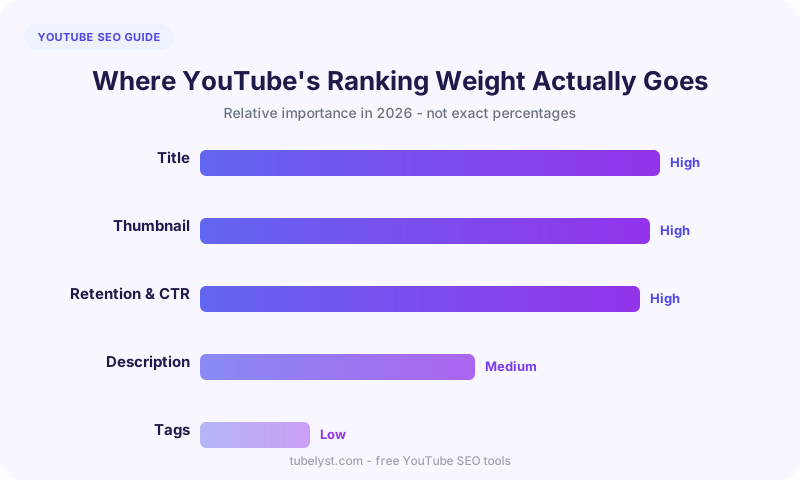
Where YouTube's ranking weight actually goes
Why the tags are dead and tags still matter camps are both a little right
Creators who say tags are dead are describing their weight in ranking, which is genuinely small now - smaller than title, thumbnail, or retention by a wide margin. Creators who say tags still matter are usually talking about the misspelling-catching and early-signal roles, which are real but narrow. Neither side is being dishonest; they are answering slightly different questions.
The Shorts exception worth knowing
Tags carry a bit more relative weight on Shorts than on long-form video, since a Short usually has less spoken content and description text for YouTube system to read for context in that first window after upload. If you post Shorts, a few well-chosen tags are more worth the two minutes than they are on a 20-minute long-form upload.
How to actually spend your tag time well
Five to eight tags, not fifty. A couple should be the exact way people search your specific topic, a couple broader category terms, and if it is part of a series or matches your channel usual content, one or two channel-specific terms. That is genuinely the whole strategy - the return on tag #9 through #30 is close to zero.
The more useful question is not how many tags should I use - it is what is actually working for channels already succeeding in my niche. That is a checkable fact, not a guess:
- Run a few successful channels in your niche through a Tag Frequency Analyzer to see which tags they reuse across uploads, not just once
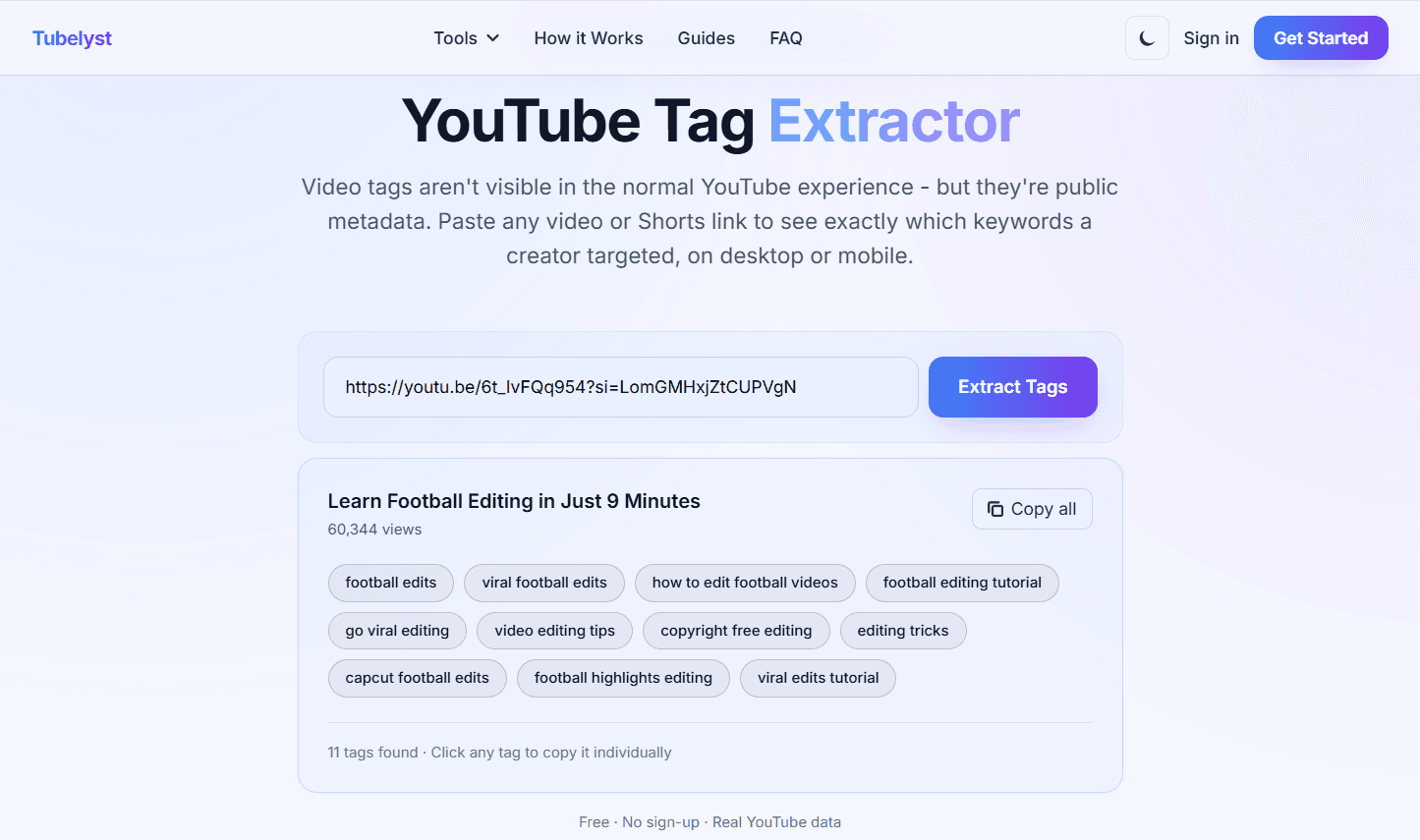
- Spot-check a specific high-performing video with the Tag Extractor to see its exact tag list
- Build your five-to-eight from what genuinely overlaps across several successful channels, not from a single video you liked
Do tags still matter - common questions
How many tags should a YouTube video have?
Five to eight relevant tags is enough for nearly any video. A couple should exactly match how people search your topic, a couple should be broader category terms, and one or two can be channel- or series-specific. Beyond that range, additional tags add little to no benefit.
Do tags help YouTube Shorts more than long-form videos?
Slightly, yes. Shorts typically carry less spoken content and description text for YouTube system to read in the hours right after upload, so tags do a bit more of the early context-signaling work there than they do on a longer video with more text and speech to analyze.
Can bad tags actually hurt a video performance?
An irrelevant or overly broad tag list can muddy the early topic signal YouTube uses right after upload, potentially showing your video to the wrong initial audience. It does not tank a strong video, but it is a real reason to keep tags relevant rather than padding the list.
Do tags still help with misspelled searches?
Yes - this is one of tags remaining direct jobs. If part of your audience searches a common misspelling or abbreviation of your topic, a tag covering that variant can help your video surface there even though your title and description use the correct spelling.
What matters more than tags for ranking in 2026?
Title, thumbnail, and audience retention all carry far more ranking weight than tags now. If you are deciding where to spend limited optimization time on a video, all three of those come before tags - tags are worth minutes, not hours.